How to Research Market Demand Before Launch
Effective market demand research is crucial for successful product launches, guiding decisions on target customers, pricing, and strategies.
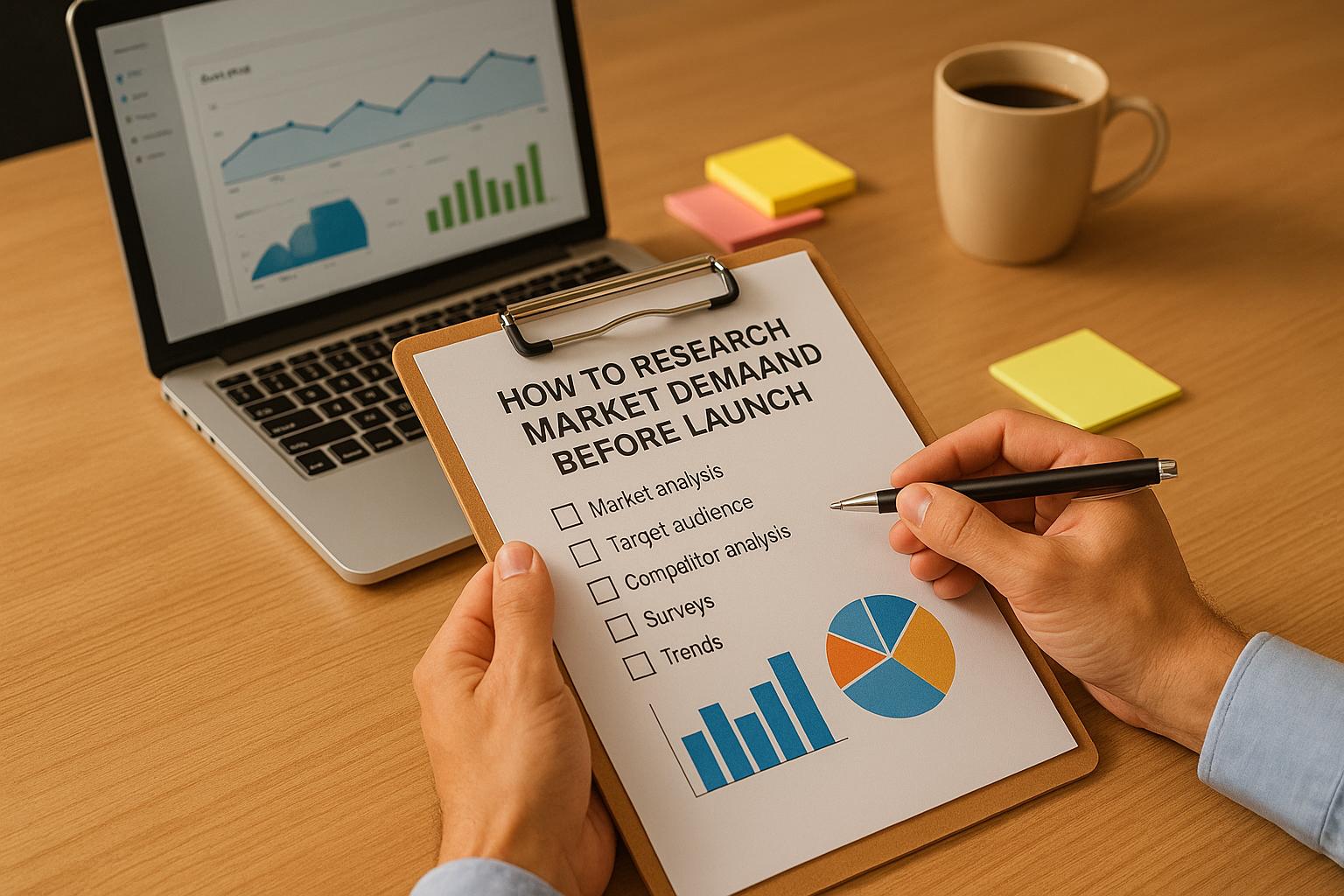
How to Research Market Demand Before Launch
Market demand research is essential for a successful product launch. Without it, you risk creating something no one wants or pricing it incorrectly. Here's what you need to know:
- Start Early: Research before investing heavily. Validate your idea and identify customer needs upfront.
- Set Clear Goals: Know what questions you're answering - like who your customers are, what problems they face, and how big the market is.
- Use Data Wisely: Combine free resources (like U.S. Census data) with customer surveys, interviews, and AI tools for a complete picture.
- Test Assumptions: Turn guesses into measurable tests, like "Will 40% of our target audience respond positively to a demo?"
- Study Competitors: Analyze their pricing, features, and customer feedback to find market gaps.
- Track Trends: Use tools like Google Trends or industry reports to stay ahead of shifts in customer behavior.
- Organize Findings: Use comparison charts, timelines, and priority lists to turn research into actionable strategies.
Key takeaway: Research helps you avoid costly mistakes, tailor your product to real customer needs, and confidently plan your launch. Use tools like surveys, AI platforms, and competitor analysis to make data-driven decisions.
Testing Market Demand for Your Startup Idea or New Product Features [Open Office Hours]
Step 1: Set Clear Research Goals
Before jumping into market research, it's crucial to know exactly what you're aiming to uncover. Without defined goals, you risk gathering a pile of random data that doesn’t lead to actionable insights. Think of this step as creating a roadmap that guides your research efforts. These clear goals will also play a key role in validating your market later on.
At this stage, entrepreneurs focus on gathering the most important information that will shape their launch strategy and business model. The idea is to zero in on data that directly impacts your decisions, not to get lost in irrelevant details.
To start, identify the key questions you need answers to and turn them into measurable assumptions that will steer your research.
List the Key Questions You Need to Answer
Write down questions that directly influence your business model. Keep them practical - no vague or overly broad inquiries. The goal is to gather data that informs decisions about your product, pricing, and marketing.
Your questions should address three critical areas: customer identification, problem validation, and market opportunity.
- Customer identification: Understand who your target customers are by looking at their demographics, buying habits, pain points, and decision-making processes.
- Problem validation: Confirm that the problem you’re solving is significant to your audience. For example, how do they currently deal with this issue? How much time or money do they spend on it? Are they actively seeking solutions?
- Market opportunity: Gauge the business potential by analyzing market size, pricing expectations, competition, growth trends, and potential obstacles like seasonal shifts or regulations.
Ask yourself questions like, "What specific issue is causing my target audience frustration?" or "What price point feels realistic for customers to invest in solving this problem?" These types of questions push you to dig deeper into customer needs and motivations, going beyond surface assumptions.
Timing also matters. Consider when customers are most inclined to purchase, how long their buying process typically takes, and what triggers them to start looking for solutions.
Once your key questions are clear, the next step is translating them into testable assumptions.
Create Testable Assumptions
Now that you’ve outlined your questions, turn them into assumptions you can measure. These assumptions are essentially educated guesses about customer behavior, market conditions, or business potential. The trick is to make them specific and measurable so you can validate them with data.
For example, instead of assuming "people will like my product", create a measurable assumption like, "At least 40% of working parents aged 25-40 will show strong interest in this solution after seeing a demo."
Here are a few areas to focus on:
- Market size assumptions: Be realistic and specific. Instead of claiming you’ll dominate a global market, aim for something like, "We can reach 2,000 customers in our metropolitan area within the first year."
- Pricing assumptions: Base these on customer psychology and competitive benchmarks. For instance, "Customers will pay $50-$80 for this solution", or "Businesses will invest up to $500 monthly if we can demonstrate a 3x return on investment."
- Customer behavior assumptions: Reflect actual decision-making processes in your industry. For example, "60% of our target audience researches solutions online before purchasing", or "Decision-makers typically need approval from two other stakeholders before committing."
To ensure your assumptions are actionable, include measurable elements like numbers or timeframes. Set deadlines for testing so you can quickly determine whether your assumptions hold up in real-world scenarios. For example, you might test whether a specific pricing model resonates with customers within the next three months.
Step 2: Find and Define Your Target Market
Pinpointing your target market is a crucial step to ensure your product or service meets real customer needs. Once you’ve set your research goals, the next task is to identify your ideal customers by examining both their demographics and behaviors. This means going beyond basic details like age or income. Instead, think about where your customers live, what influences their decisions, and how they act in the marketplace.
Focusing on the right audience streamlines your research and makes your marketing efforts more effective. You’ll gather data that’s relevant to the people most likely to buy from you, avoiding wasted time and resources. A clear understanding of your market also helps you choose reliable data sources for your research.
The sweet spot lies in combining solid demographic data with insights into customer behavior and preferences. Together, these elements provide a well-rounded view of your market potential.
Use U.S. Government Data Sources
The U.S. government offers a treasure trove of free data to help you understand your local market. These resources provide dependable, up-to-date information on population trends, economic conditions, and business environments in specific areas.
- The U.S. Census Bureau: Through the American Community Survey, you can access annual data on income, education, housing, employment, and family structures for cities, counties, and metro areas. For example, if you’re planning to launch a premium pet service, Census data can help you identify high-income neighborhoods with a strong presence of pet owners.
- The Bureau of Labor Statistics (BLS): The BLS provides insights into employment trends, wages, and consumer spending habits. Their Consumer Expenditure Survey, for instance, breaks down how Americans spend their money by income level, age group, and region. This can help you understand how your target customers prioritize their budgets.
- The Small Business Administration (SBA): The SBA offers tools like the SizeUp platform, which lets you analyze local competition, pinpoint market gaps, and explore economic trends relevant to your industry.
State and local economic development agencies are also excellent sources of information. Many publish reports on industry trends, workforce analyses, and economic forecasts, which can shed light on opportunities and challenges specific to your area.
When using government data, prioritize information from the last two to three years. Economic and demographic shifts can happen quickly, especially in fast-changing communities.
Study Customer Attitudes and Buying Patterns
While government data gives you a solid foundation, understanding customer behavior helps you uncover what truly drives their decisions. This involves digging deeper into their values, motivations, and purchasing habits.
- Look at purchasing triggers. What situations prompt your customers to seek solutions? For example, parents might start searching for educational apps when their kids struggle in school, or small business owners might look for accounting software when tax season becomes overwhelming.
- Understand spending priorities and decision-making. Different groups spend their money based on what they value most. Young professionals might lean toward convenience and time-saving options, while families often prioritize safety and affordability. Knowing these priorities helps you tailor your pricing and messaging.
- Explore how customers discover products. Do they rely on online reviews, social media, word-of-mouth, or professional networks? This insight helps you choose the right marketing channels.
- Identify seasonal trends. Many industries experience predictable ups and downs. Retailers, for instance, see a surge during the holidays, while tax preparation services are busiest in early spring. Recognizing these patterns allows for better planning and timing.
- Consider regional and cultural preferences. Customer needs and attitudes can vary widely based on geography. Urban customers might look for different features than rural ones, and regional preferences can shape everything from product design to advertising strategies.
To gather this kind of behavioral data, use tools like surveys, focus groups, and interviews. Platforms like Google Trends can also show you what’s gaining or losing popularity in your target market over time.
Finally, consider how your audience currently solves the problem you’re addressing. What alternatives do they use? What frustrations do they have with existing solutions? These insights can help you position your product as a better alternative and address unmet needs.
Defining your market with precision sets the stage for using advanced research tools, including AI-powered options, in the next steps.
Step 3: Use Market Research Tools and Methods
Once you've outlined your target market, the next step is to gather data that will confirm whether your business idea is viable. A smart mix of research tools and methods can help you collect both numerical data and customer insights. By combining traditional techniques with modern AI-powered solutions, you can get a clearer picture of market demand.
The trick is to choose methods that align with your goals and budget. Some approaches are better for understanding customer emotions and motivations, while others excel at analyzing trends and measuring demand. Using multiple methods together allows you to cross-check your findings for accuracy.
Standard Research Methods
Traditional research methods are still essential because they provide direct insights into customer thoughts and behaviors. These tools help you understand not just what people do, but why they do it.
Surveys are a reliable way to collect quantitative data from large groups. They work best when you need to measure specific attitudes, preferences, or behaviors across your target audience. Online platforms like SurveyMonkey and Google Forms make it easy to reach a wide audience at a low cost. To maximize participation, keep surveys short - around 5–10 questions that take no more than 3–4 minutes to complete. You might also offer small incentives, like gift cards or early product access, to encourage responses.
Interviews provide deeper, qualitative insights that surveys can't capture. A 20–30 minute conversation can reveal motivations and decision-making processes. Aim to conduct at least 10–15 interviews to start identifying patterns. Use open-ended questions like, "Can you describe the last time you faced this issue?" or "What steps do you take when buying products like this?" Don’t forget to record the interviews (with permission) so you can revisit them later for additional insights.
Focus groups, which involve 6–8 participants from your target market, are great for testing concepts like messaging, pricing, and features. However, they do have limitations - dominant personalities can skew discussions, and participants might say what they think is socially acceptable rather than what they truly feel. Use focus groups to brainstorm ideas and explore concepts, but don't rely on them for major decisions.
Online communities and forums are another valuable resource. Platforms like Reddit, Facebook groups, LinkedIn communities, and niche forums provide a window into authentic customer conversations. Look for complaints about current solutions, requests for features, and pricing discussions to identify gaps in the market. Keep in mind that many communities have strict rules about self-promotion, so focus on being helpful and sharing relevant insights.
While these traditional methods provide direct feedback, modern tools can complement them by offering data-driven insights into broader trends.
AI-Powered Market Research Tools
AI tools have revolutionized market research by automating tasks that used to take weeks or months. These tools can quickly process large amounts of data, uncover patterns, and deliver actionable insights - all at a lower cost.
Idealyze is a standout AI-powered platform specifically designed for entrepreneurs. It generates daily business ideas based on market trends and offers detailed analyses of market opportunities, competitive landscapes, and financial projections. Its Ideas Vault feature allows you to sift through thousands of startup concepts using advanced filters, helping you identify underserved segments. The platform also includes Imagine Lab, which creates landing pages and marketing materials to test market response. This lets you gauge demand based on actual customer behavior rather than survey responses, providing valuable data to refine your approach.
Google Trends is another accessible AI tool. It tracks search volume patterns over time, geographic interest, and related queries. This can help you identify seasonal demand, regional preferences, and shifts in interest within your market. Pay special attention to the "Related Queries" section, which can reveal customer concerns or emerging opportunities you might not have considered.
Social media listening tools monitor conversations across platforms like Twitter, Instagram, LinkedIn, and TikTok. These tools track mentions of keywords, competitors, and relevant topics. More advanced options can analyze sentiment, identify influencers, and detect emerging trends before they gain widespread attention. By observing not just what people say but how they feel about existing products, you can uncover opportunities for improvement.
AI-powered competitive analysis platforms keep tabs on competitor activity, including pricing changes, product updates, marketing campaigns, and customer reviews. Some tools even analyze competitor websites and advertising strategies, giving you a clearer picture of what works in your industry and where opportunities exist.
Predictive analytics tools use machine learning to analyze historical data and economic indicators, helping you forecast demand and evaluate sensitivity to pricing, features, or other variables. These tools are especially useful if you have historical data to work with, as they can guide data-driven decisions.
The best results come from combining AI tools with traditional methods. Use AI to uncover trends and opportunities, then validate those findings with direct customer feedback through surveys and interviews. This approach provides both a broad market overview and detailed insights into customer behavior.
When using AI tools, specificity is key. Instead of seeking general market information, focus on targeted questions - such as pricing sensitivity, feature preferences, or regional demand. The more precise your questions, the more actionable your results will be.
sbb-itb-0245d19
Step 4: Study Your Competition and Market Trends
Knowing your competition and staying on top of market trends are key to finding untapped opportunities and positioning your product effectively. This process involves more than just identifying competitors - it’s about digging into their strategies, understanding shifts in your industry, and figuring out how to stand out.
By analyzing competitors, you can see what’s already working in your market and where customers might feel underserved. Keeping an eye on industry trends helps you anticipate changes and adjust your strategy to stay ahead. Together, these insights can guide decisions about pricing, features, and how to position your product in the market.
Research Your Competitors
Start by identifying two types of competitors: direct competitors, who offer similar products or services, and indirect competitors, who provide alternative solutions to the same problem. For example, if you run a meal delivery service, your direct competitors would be other meal delivery companies, while indirect competitors might include grocery stores offering pickup or meal kit services.
To get a clear picture, evaluate competitors’ websites, pricing, customer support, and marketing efforts. Take note of their key selling points and document these in a comparison chart. Review their social media, email campaigns, and ads to see how they engage with customers. Pay attention to things like homepage messaging, product descriptions, and user experience.
Customer feedback is another goldmine. Check reviews on platforms like Google Reviews, Yelp, or Amazon, and look for patterns. If customers frequently mention challenges like complicated setup processes or poor support, these could be areas where you can shine. Also, watch for comments about customers switching from one competitor to another - these often reveal what drives their decisions, including pricing concerns.
Dive deeper into their content and advertising strategies using tools like Facebook Ad Library or Google’s Ads Transparency Center. Analyze the topics they cover, how often they post, and the level of engagement. This can help you understand what resonates with your shared audience.
Finally, create a comparison chart that objectively lists factors like pricing, features, customer service, brand recognition, and market share. This will help you pinpoint where competitors excel and where you can offer something better. The goal isn’t to copy them but to understand the landscape and carve out your own space.
Once you’ve got a handle on your competition, it’s time to look at the bigger picture - industry trends.
Track Industry Changes
Building on your competitor research, it’s equally important to monitor broader industry trends. This helps you stay ahead by anticipating shifts rather than just reacting to current conditions.
Social listening tools can be incredibly useful here. They let you track what people are saying about your industry on social media, forums, and news sites. For example, in 2020, a surge in discussions about "contactless" services signaled a major shift in customer preferences across industries.
Stay updated by following industry publications and thought leaders who regularly share insights. Subscribing to newsletters, trade publications, and research reports can keep you informed about new developments. Google Alerts is another handy tool for tracking mentions of key industry terms or emerging technologies.
Keep an eye on regulatory updates and economic indicators through trusted sources like government websites or industry reports. Resources such as the U.S. Census Bureau, Bureau of Labor Statistics, and the Federal Reserve provide valuable data. For more specific insights, look into industry-focused indicators.
If you’re interested in spotting new technologies early, check out patent filings and academic research. Platforms like Google Patents or academic databases can help you identify trends before they hit the mainstream.
Attending industry conferences and networking events is another great way to stay informed. Whether in-person or virtual, these events offer the chance to hear directly from experts about the challenges and opportunities shaping your market. Pay attention to recurring themes - they often hint at where the industry is headed.
Finally, data platforms offering market research and trend analysis can provide deeper insights. While some reports require a subscription, many offer free summaries with key takeaways that can guide your strategy.
Consistency is key when tracking trends. Look for overlap between multiple trends, as these intersections often reveal the biggest opportunities. For instance, the combination of remote work, advances in video technology, and changing consumer habits has driven growth in virtual events and online education.
Not every trend will impact your market directly, so focus on the ones that affect your target customers’ needs, behaviors, or buying decisions. By understanding both your competition and the broader industry landscape, you’ll be well-equipped to refine your strategy and position your product for success.
Step 5: Organize and Use Your Research Results
Now that you've gathered and analyzed your research, it's time to turn that information into actionable strategies. Without organization, even the best data can feel overwhelming and, frankly, useless. The goal here is to structure your findings into a clear roadmap that drives decisions. Companies that excel in this step don’t let their research sit idle - they act on it immediately.
Create Charts and Comparison Tables
Visualizing your data is one of the most effective ways to identify patterns and make informed decisions. Group similar findings - like customer feedback, competitor pricing, or market trends - into visuals that simplify complex information.
- Competitor analysis tables: Use these for side-by-side comparisons. Include columns for company names, pricing tiers, key features, customer ratings, and market positioning. This format quickly highlights gaps and opportunities in the market.
- Customer preference charts: If you’ve surveyed potential customers, bar charts can show the percentage of respondents interested in specific features. For example, if 200 people were surveyed, a bar chart can make it obvious which features matter most. Similarly, demographic breakdowns can be presented as pie charts or segmented bar graphs.
- Market demand visuals: Line graphs can highlight search volume trends over time, showing seasonal demand or growing interest. Geographic heat maps are great for pinpointing where demand is strongest, which can guide decisions about launch locations. Scatter plots work well for price sensitivity, showing how price impacts purchase intent.
- Trend analysis timelines: Plot key industry changes, competitor launches, and market shifts on a single timeline. This can reveal cause-and-effect relationships, helping you make smarter decisions about timing.
For all visuals, maintain consistent formatting and clear labels. Stick to a single color scheme and include data sources at the bottom. This not only makes your findings easier to understand but also adds credibility when presenting to stakeholders like investors or partners.
- Comparison matrices: For more complex decisions, these are incredibly helpful. List evaluation criteria (e.g., market size, competition, profit potential) on one side, and rate each opportunity on a scale of 1-5. The highest scores should guide your priorities.
Once your data is visualized and organized, it’s time to translate those insights into strategic actions.
Turn Research into Business Actions
The real value of research lies in what you do with it. Use your findings to refine product features, pricing, marketing strategies, and more. This step is about moving from "interesting data" to meaningful business changes.
- Product development: Let customer research guide your decisions. For example, if 70% of survey respondents want a mobile app but only 30% care about desktop functionality, focus your development efforts on mobile. Build what your customers actually want.
- Pricing strategy: Competitive and customer data can make pricing decisions much clearer. If customers see value in a $50 monthly price while competitors charge $75, you can undercut them while maintaining solid margins. On the other hand, if customers prioritize quality over price, you might position your product as a premium offering.
- Marketing positioning: Use your research to shape messaging. If customers consistently describe their problems using specific terms, incorporate that language into your marketing copy. If competitors focus on features but customers care more about results, shift your messaging to emphasize outcomes.
- Launch timing and location: Trend analysis and geographic data can guide these decisions. For instance, if demand peaks during certain seasons, schedule your launch accordingly. If specific cities or regions show higher interest, consider a targeted rollout rather than a nationwide launch.
- Channel strategy: Customer research often reveals where your audience spends their time. If they rely on industry publications instead of social media, allocate your marketing budget accordingly. And if competitors dominate traditional channels, explore alternative approaches to stand out.
Create a priority action list based on how confident you are in your research. High-confidence insights with strong data support should take precedence. Medium-confidence findings might warrant small-scale testing, while low-confidence areas should be monitored without driving decisions.
Make Smarter Resource Allocation Decisions
Clear organization of your research simplifies how you allocate resources. For example, if customer interviews repeatedly highlight one pain point, dedicate more development time to solving it. If market size data shows one segment is significantly larger, shift your team’s focus to capture that opportunity.
Set up tracking systems to measure whether your research-based decisions are paying off. For instance, if you set pricing based on survey results, monitor actual sales behavior. If you positioned your product to exploit competitor weaknesses, track customer responses to your messaging.
Finally, document your reasoning behind major decisions tied to research. This creates a valuable record for your team, helping you understand which insights were most impactful. Over time, this builds a playbook for what types of research drive the best results in your industry.
Conclusion: Main Points for Market Demand Research
Market demand research is the backbone of a successful product launch. By gathering pre-launch data, you create a clear roadmap that helps you avoid costly missteps and ensures your product meets real customer needs.
Review of the Research Process
The research process is a step-by-step journey that builds momentum as you progress. Setting specific goals at the outset provides direction and prevents you from being overwhelmed by irrelevant information. Asking the right questions ensures that every piece of data collected serves a purpose.
Understanding your target market is crucial. Identifying gaps in your assumptions early on allows you to adjust your strategy before investing too much time or money. The insights you gather here shape how you approach everything from product design to marketing.
Choosing the right tools and methods is equally important. While traditional options like surveys and focus groups remain useful, AI-powered platforms can now process vast amounts of data in hours, not weeks. The key is to match your tools to your specific research needs rather than using every method available.
Looking at competitors and market trends adds context to your findings. Your product doesn’t exist in isolation - knowing how competitors position themselves and where the market is heading helps you uncover opportunities you might otherwise miss. This analysis can also reveal whether you're entering a thriving market or one that’s on the decline.
The insights you gather should lead to immediate action. Companies that excel in market research don’t let their findings sit idle. Instead, they use them to shape product development, pricing strategies, and marketing plans. Each step in the process feeds directly into creating a well-informed launch strategy.
How AI Makes Market Research Easier
AI has transformed market research, making advanced tools accessible to even small teams or solo entrepreneurs. What once required large budgets and specialized expertise can now be done with AI platforms that streamline the entire process.
AI’s speed and scale are game-changers. It can analyze thousands of customer reviews, social media posts, and search trends in minutes, uncovering patterns that would take human researchers weeks to find. This speed allows for quick testing of multiple ideas and adjustments based on real-time feedback.
AI also excels at spotting subtle patterns that might go unnoticed with manual analysis. For example, it can identify nuanced trends in customer behavior and preferences that traditional methods might miss.
Another advantage is the integration AI offers. Instead of juggling separate tools for tasks like surveys, competitor research, and trend analysis, AI platforms bring everything together. This ensures consistency and reduces the risk of missing connections between different data sets.
The combination of AI and human expertise creates a powerful research approach. AI takes care of the heavy lifting - data collection and initial analysis - while you focus on interpreting the results and making strategic decisions. This partnership allows you to conduct thorough market research, even with limited time and resources, giving you the confidence to launch with data-driven insights.
FAQs
How can I combine traditional market research methods with AI tools for better results?
To bring together traditional market research and AI tools effectively, start by leveraging AI to simplify data collection and analysis. AI excels at processing massive datasets at lightning speed, uncovering patterns, and highlighting insights that might slip through the cracks with manual efforts. This frees up your time to focus on interpreting the findings and crafting strategic decisions.
AI also takes predictive analytics to the next level, helping you forecast market trends and understand consumer behavior more accurately. On top of that, it can refine survey design by customizing questions for your target audience, ensuring the feedback you collect is both relevant and actionable. By combining the tried-and-true methods of traditional research with AI's speed and precision, you can gain a clearer picture of market demand and make smarter, data-driven decisions.
What mistakes should I avoid when researching market demand for a new product launch?
When diving into market demand research, steering clear of common pitfalls is key to getting accurate insights. For starters, steer away from outdated or narrow data sources. Make sure your research pulls from up-to-date and varied information to get a well-rounded view.
Another trap to avoid is misinterpreting data by zeroing in on isolated numbers. Instead, focus on the bigger picture - look at trends and consider external influences that might impact your findings. And don’t let confirmation bias sneak in. Stay objective by analyzing data from multiple angles and involving diverse viewpoints to keep your conclusions balanced.
Also, don’t rely solely on technology to do the heavy lifting. AI tools are undeniably helpful, but human judgment is crucial for grasping nuances like cultural context and subtleties that machines can miss. Lastly, ensure that your research is tied to clear business objectives. Without defined goals, your work can lose direction and fail to produce actionable insights.
How can I make sure my assumptions about my target market are testable and lead to useful insights?
To make sure your assumptions about your target market can be tested and lead to actionable insights, start by breaking them down into smaller, more specific statements. Zero in on the critical unknowns that could make or break your business idea and focus on testing those first. This way, you can concentrate on what truly matters instead of spending time on areas with less impact.
Each test should deliver clear answers that help you decide your next move - whether that's sticking to your plan, tweaking your strategy, or even rethinking your entire idea. By using real-world data to validate your assumptions, you'll be able to make smarter decisions and minimize the risks tied to launching your product or service.